



Key Takeaways
- Increasing regulatory oversight, tax changes, higher mortgage costs and evolving tenant protections have made buy to let a more “hands-on” and financially complex investment.
- Although tenanted property sales have therefore become increasingly common in recent years, it’s important to weigh up your options carefully.
- Choose the right sales route for your priorities: estate agents (private treaty) may achieve higher prices but take longer; auctions suit investor buyers; “we buy any home” firms like Property Solvers bring speed and certainty (with offers typically at 70-75% below the market value with no fees).
- Selling with tenants in situ usually attracts landlords/investors, seeking strong yields and risk-adjusted returns. Many will price (i.e. value your property) conservatively.
- Selling with vacant possession widens the buyer pool but is likely to take longer, particularly when selling on the open market.
Introduction to Selling a Tenanted Property
Before we get into the details, please check out a short video I recorded that breaks down the key considerations landlords should weigh up when deciding to sell a tenanted property.
It covers the current realities, our own experience of selling buy to let assets alongside 10-steps on how to sell efficiently, stay compliant and achieve a strong outcome, even with tenants in place.
Why Does Selling a Tenanted Property Make Sense in 2026?
It’s somewhat easy to see why selling a tenanted property may not be the best of ideas.
Letting go of a long-term appreciating asset with regular rent arriving each month is indeed a tough decision to make.
These days, however, the reality of being a landlord is often more complex.
Increased regulation, evolving tenant protections and rising operational costs mean residential buy-to-let is no longer a passive, “set and forget” investment. It now requires a far more involved, professional approach.
At Property Solvers, we regularly speak with landlords who are reassessing whether holding on still makes sense. Below, we outline some of the most common reasons they decide that selling a tenanted property is the right way forward…
Buy-to-Let is Not as Profitable These Days

While “bricks and mortar” is often seen as more tangible than the stock market, buy-to-let now carries a wider range of financial risks – particularly for landlords with significant mortgage (secured) borrowing.
Rising costs across the board have eroded net returns. When these pressures are weighed against the time, risk and capital tied up, many landlords conclude the numbers no longer stack up.
Ongoing Property Market Risks

The post-pandemic surge in house prices was driven by temporary factors, including stimulus measures such as the Stamp Duty holiday. That period of rapid growth has largely passed.
With inflation remaining sticky and buyer confidence more fragile, future capital growth is far less predictable. For some landlords, selling can be a sensible way to manage risk and crystallise existing gains.
Stubborn Inflationary Pressures

Related to above, inflation remains a concern for households and investors alike, affecting everyday costs as well as longer-term financial planning.
For landlords, this increasingly shows up in higher overheads such as insurance premiums, maintenance and repair costs, alongside compliance obligations and necessary periodic refurbishments.
Even when inflation eases, uncertainty makes it harder to forecast returns, and any future base rate cuts do not automatically improve buy-to-let cashflows.
Higher Buy to Let Mortgage Rates

Again related to the previous two points, although base rates are expected to ease gradually, they are unlikely to return to the ultra-low levels seen before 2020. Any reductions are also likely to be cautious rather than aggressive.
While policy rates influence funding costs, most fixed-rate buy-to-let mortgages are priced using swap rates shaped by longer-term inflation expectations.
As a result, buy-to-let mortgage rates may remain structurally higher than in previous cycles, limiting the benefit of base rate cuts for landlords.
The ‘Section 24’ Effect

The removal of mortgage interest relief under Section 24 of the Finance (No. 2) Act 2015 took many landlords by surprise.
This legislation essentially means that landlords can only offset 20% of their mortgage interest costs against their total rental receipts / revenues (in the form of a credit).
In short, unlike any other business, landlords are taxed on their profits.
At most risk are those in the higher and additional rate tax bracket. Today, many landlords we talk to are being classed as higher rate taxpayers, even though they’re not earning extra income!
In the examples below, we assume that Landlord A and Landlord B own very similar properties. The market values are both £100,000, achieving a gross yield of 7.2% – i.e. £600 per calendar month in rent – after the full effect of the legislation (in the 2020/21 tax year).
 Landlord A Landlord A20% Tax Band |
 Landlord B Landlord B40% Tax Band |
|
|---|---|---|
| Before Section 24 Changes | ||
| Annual Rental Income | £7,200 | £7,200 |
| Annual Tax Deductible Mortgage Interest (100%) | £3,600 | £3,600 |
| Annual Pre-Tax Profit | £3,600 | £3,600 |
| Tax on Profit | £720 (20%) | £1,440 (40%) |
| Net (Post-Tax) Profit | £2,880 | £2,160 |
| Effective (Post-Tax) Income Yield | 2.88% | 2.16% |
| Section 24 Changes Fully Phased In (2020/21) | ||
| Annual Rental Income | £7,200 | £7,200 |
| Annual Tax Deductible Mortgage Interest | £0 | £0 |
| Annual Pre-Tax Profit | £7,200 | £7,200 |
| Tax on Profit | £1,440 (20%) | £2,880 (40%) |
| Mortgage Cost Relief | £720 (20%) | £720 (20%) |
| Tax Owed | £720 | £2,160 |
| Net (Post-Tax) Profit | £2,880 | £1,440 |
| Effective (Post-Tax) Income Yield | 2.88% | 1.44% |
The above assumptions also do not factor in non-mortgage interest costs such as voids, legitimate running expenses and other holding obligations. These overheads will remain fully deductible against gross rental income (revenue).

At Property Solvers, this isn’t just a theoretical issue. Ruban Selvanayagam and James Durr – the company’s co-directors – have personally sold a number of rental properties in recent years after reassessing the financial returns, tax exposure (largely Section 24) and long-term risk profile.
Note that if you have zero or low mortgage debt against your rented property or own your property through a Limited Company, Section 24 is unlikely to impact you.
However, before you think about selling, we suggest approaching a professional accountant or tax advisor as every landlord’s situation is different. Remember also to calculate your Capital Gains Tax liability.
Renters’ Rights Act

This legislation strengthens tenant protections and reduces flexibility for landlords, particularly around possession and long-term exit planning.
For some landlords, this added uncertainty is enough to trigger a reassessment of whether continuing to hold a tenanted property still makes sense.
Increased Regulation

Somewhat related to the above, the government has begun to roll out a number of regulatory measures aimed at improving quality standards across the private rented sector.
Examples include selective licensing, heavier local council enforcement mechanisms and wider registration requirements.
Of course, raising standards should certainly be welcomed – especially given the growing evidence of “slumlording”. But it’s fair to say that most landlords will continue to face higher costs to run their operations.
Costly Energy Efficiency Improvements

Proposed minimum EPC C requirements could place further strain on landlord cashflows. From our own refurbishment experience – mainly terraced houses, semi-detached homes and flats – upgrade costs can range from £20,000 to £100,000, depending on location and whether works involve a full “back-to-brick” renovation.
End of the Buy-to-Let ‘Boom’

The stamp duty surcharge introduced some years ago, along with tighter mortgage affordability rules and increased tax burdens, has cooled parts of the buy-to-let market.
As explained below, rental property should be valued differently from owner-occupied homes. With affordability pressures limiting buyer demand and higher effective taxation reducing net returns, expectations of guaranteed long-term price growth can often be overstated.
The idea that house prices reliably double every ten years is a myth and clearly disproven.
Difficulty in Raising Rents

By and large, landlords are rent takers – not makers. Rents may end up rising due to limited market supply, but this is not a dead cert. Landlords should also be wary of affordability issues.
Already taking up a significant share of people’s take-home pay, low wage inflation may mean that the risk of arrears could rise if rents are raised too much.
Besides that, landlords are generally disliked and vilified by certain sections of the media (not to mention left-leaning opinion). Any aggressive increases will not do us any favours.
Local Housing Allowance (LHA) Caps

Landlords operating in the Local Housing Allowance (LHA) space continue to grapple with lower benefit receipts. This is making the financial viability of these rental properties less profitable.
Delays in processing Universal Credit housing benefit claims and under-resourced local authorities are also not helping matters. To make things worse, many mortgage lenders still don’t want anything to do with these types of properties.
Refurbishment Works Required

Your rented property may need significant refurbishment that you do not have the time, budget or inclination to do yourself.
Growing material and labour costs are further adding to the problem. Sometimes it’s easier and more cost-effective to sell up “as is” to avoid the stresses and hassles.
Problem Tenants

Most experienced landlords would have had at least one bad tenant.
A trashed house, months of unpaid rent and a legal system that favours tenants can easily result in a decision to simply sell up.
The Rise of Build to Rent and Institutional Landlords

Institutional investors are playing a growing role in the rental market, with build-to-rent activity now extending beyond city centres and into suburban areas.
With access to scale, capital and professional management, these operators often set higher benchmarks for property standards and tenant experience.
As a result, smaller landlords may find it harder to compete – particularly where additional investment is required to maintain or upgrade older stock.
Release “Locked In” Equity from Your Buy to Let

You may decide to release capital to benefit from greater financial flexibility. This could involve reducing debt, diversifying into other investments or simply holding cash.
For many landlords, after paying the due taxes, unlocking equity also helps fund lifestyle choices such as retirement planning, travel or supporting family and future generations.
Selling a Rented Property – Your Real Options
If you have decided to sell, the next step is to choose the route that best fits your objectives.
Much will depend on how quickly you want to dispose of the property and whether price is more important than speed.
The options below range from the most immediate (lower end value) to more involved (higher end value) approaches:

Using a “Sell House Fast” / “We Buy Any Home” Company
Quickest and least hassle (with no fees), but at a discounted price.

Auction (Traditional or Modern Method)
Common for tenanted properties and frequently attracts investor buyers.

Selling to a Private Investor (Landlord-to-Landlord)
A more discreet and direct route if the numbers stack up on both sides of the transaction.

Using a High Street or Online Estate Agent
Often aimed at achieving the strongest price, and best when the property is vacant, but usually slower and less certain.
Let’s now look at each option in more detail…
Selling Your Rental Property to a “Sell House Fast” Company
Growing in presence across the UK since the early 2000s, “sell house fast” or “we buy any house” firms are essentially professional cash buyers.
You can expect to achieve between 70% and 75% of the market value, depending on its condition.
The advantage is that your house will be sold much faster than through an estate agent or auctioneer. Reputable firms will also pay your legal (conveyancing) costs and, as it’s a direct sale, there are no estate agency fees.

The Upsides of a Fast (Cash) Tenanted Property Sale
- Cash buyers do not depend on mortgages and there is no onward chain – meaning sales can complete rapidly (typically within 7 to 28 days).
- The reputable firms are experienced purchasers who acquire multiple properties every month and know how to handle transactions quickly.
- Companies like ours are landlords and understand the realities of tenanted property sales (and how to remove much of the stress from the process).
- There’s no “uming” and “ahing”, and the good firms will not wish to risk negative reviews by acting slowly.
- All properties will be considered – buyers won’t be “scared off” by problem tenants, structural issues, legal complications or properties struggling on the open market (for a variety of other reasons).
- Most firms will buy when tenants are in arrears or refusing to leave.
- You’ll save on ongoing holding costs, as a quick sale avoids continued mortgage payments, voids, council tax, maintenance and other household “overheads”.
- There will be minimal disruption with no FOR SALE boards, repeated viewings or drawn-out negotiations.
- You’ll typically have a direct point of contact at the firm to ask questions whenever you need to during the process.

As professional landlords ourselves for over 20 years, Property Solvers are actively seeking property portfolios and tenanted investments. We focus on providing “win win” solutions – whether you’re looking for a quick, hassle-free sale or a more structured disposal.
The Downsides of a Fast (Cash) Tenanted Property Sale
- The discounted price (in exchange for a quick sale with no fees) is off-putting to many sellers.
- Not all firms are equal and due diligence is essential to avoid companies that may renegotiate late in the process (sadly, a common practice).
- There’s less exposure to the open market. You are prioritising speed and certainty over testing maximum buyer demand (and therefore a stronger price).
- Related to the above, avoiding a competitive bidding environment at auction may leave you with “seller’s remorse”.
What to Look Out for with
“We Buy Any Home” Companies

- Make sure that the company is registered at the National Association of Property Buyers (NAPB).
- Be wary of quick sale companies that will “pass your property” to other (often amateur) investors. Although this can be a legitimate and feasible sales method, make sure you verify the buyer’s credentials.
- The transaction should be protected by Anti-Money Laundering regulations (governed by HM Revenue & Customs).
- Check that the correct data protection protocols are in place (by verifying registration with the Information Commissioner’s Office).
- Make sure you understand HM Land Registry / ONS sold prices in your area so you don’t get misled. It’s also worth using professional (rather than anecdotal) criteria such as “Red Book” standards.
- Check that the firm is registered with Companies House (where you can also view their annual returns, see how long they have been in business, and download information about the Directors). Remember that many fast house sale companies have similar names.
- If the buyer is an individual, ask for their personal credit report (from a reputable agency such as Experian or Check My File). You can also obtain more specific information about the company as a whole using these services.
- Make sure there are no hidden charges. You may want to ask an independent solicitor to look through any contractual agreements.
- If you’re unsure about the company, ask to see proof of cash funds. Genuine quick cash buying firms should be able to show a recent bank statement or a letter from a solicitor (duly registered with The Law Society and/or the Solicitors Regulation Authority). Proof of an undrawn debt facility may also be valid, but you should check the details (and credibility) of the finance source.
- The established companies will have customer reviews on sites like Trustpilot, Google ane Reviews.io
- Ask for their previous track record (of exchanging and completing on houses quickly). Property Solvers, for example, can put seller clients in touch with contacts who have used our service.
- Request confirmation that the price will not be dropped at the last minute. Ask for a letter from their solicitor confirming that this will not occur.
- Although not essential, it may be worth checking that the landlord buyer or company is suitably accredited by organisations such as the National Landlords Association (NLA) or the Residential Landlords Association (RLA).
Remember that you are in the driving seat. The firm should never put any other pressure to sell and explain all options available to you.
Selling a Tenanted Property at Auction
These days, the auction process is far more transparent and easier to navigate.
The growth of online auction houses has also helped expand the sector significantly, making it easier for both sellers and buyers to participate.
There is also the modern method of auction – best described as a cross between a traditional auction and an estate agent sale, often allowing mortgage buyers more time to complete.
Many auction buyers are professional landlords looking to expand their portfolios. Others include refurbishment investors targeting value-add opportunities, alongside private capital diversifying into income-producing property, housing associations and other non-profit organisations.

Check out our extended post on selling your house at auction, which explores this option in depth. We also cover how the overall process works, fees, some key tips on getting the best outcome from the sale, amongst other topics.
As with any selling route, auctions come with their own advantages and drawbacks. Below, we outline some of the main pros and cons to consider…
Pros
- Auction platforms (such as Property Solvers Auctions) are popular amongst “business minded” landlords and professional investors, meaning tenanted properties are well-suited to this type of marketplace.
- You’ll very rarely find time-wasters, nit-pickers and “window shoppers” at auctions.
- Many auction buyers are experienced investors who understand problem, non-standard or complex properties and tenancy arrangements.
- Competitive bidding can help reveal the property’s true market value, particularly where investor demand is strong.
- The auction process follows a clear timetable, giving sellers greater certainty around when the transaction will complete.
- Auction buyers need to be cash ready (although many use auction bridging finance). Indeed, once the hammer falls (under traditional or unconditional auction conditions), contracts are exchanged. The buyer then has between 20 and 28 days to complete on the sale.
- If a buyer pulls out or changes their mind, the deposit (usually 10%) will eventually go to the seller. The solicitor and auctioneer also reserve the right to charge abortive fees and penalties. As a result, this scenario rarely happens.
- It’s impossible to be “gazundered” after the auction – i.e., when the buyer suddenly drops the price before exchange and completion.
- Many auctioneers (like ourselves) also deal with private and off-market sales – both potential channels to fast track property sales.
Cons
- The time it takes to actually sell a property at auction can be longer than people think. This is due to the marketing period (typically 3-4 weeks or more), viewings, organising the auction legal pack and ensuring the property gets sufficient exposure.
- In busy times, you may end up waiting further for an auction slot.
- There will be 2 to 3 open days for prospective buyers to view the property, which may cause some disruption (though you do not necessarily need to be present).
- In terms of fees, you generally pay for what you get. The well-known auctioneers offer a specialised service, meaning that commissions can be higher than what you would pay with an estate agent. Don’t be fooled by low auction fees – your property will usually be marketed poorly as a result.
- Depending on the auction house, you may also have to pay for enhanced advertising expenses, auction hosting fees and access to the online platform (and associated marketing channels).
- You will also have to cover your own legal (conveyancing) costs.
- There is a fine line in determining the “reserve” price. For example, if it is too high, people may not bid at all. If the property does not sell at this value, there is a loss of time and money (unless a buyer emerges post-auction with an acceptable offer, or you decide to sell for cash).
- You may be competing against other (similar) properties at the same auction, meaning the property could end up not meeting its reserve.
Selling to a Property Investor (Landlord to Landlord)
Selling to another landlord (typically with a tenant in situ) often means that you’re likely to be dealing with a more savvy buyer.
Beyond the condition and location, buy-to-let investors are likely to take a detailed look at key financial fundamentals of the property. This includes gross/net yield and return on cash employed (ROCE), amongst others. Be sure to have your rental property profit + loss, balance sheet and other accounts-related records at the ready.

Also, remember that many will factor in the ever-increasing regulatory and compliance risks of operating in this space into their offers.
Checklist for a Landlord to Landlord Sale

In order of priority, you’re likely to be asked for the following (the more you can provide, the better):
- The current Assured Shorthold Tenancy (AST) agreement (even if it’s periodic) and information about the tenant(s).
- Information about the other occupants at the property and how the rent gets paid (for example, if there is a head tenant or specific family member).
- Bank statements or approved accounts demonstrating rental receipts/voids.
- Confirmation of any notices served in the past and other relevant documentation.
- Evidence that the deposit has been correctly lodged at the appropriate custodial scheme (Deposit Protection Service, Tenancy Deposit Scheme or MyDeposits).
- An up-to-date Energy Performance Certificate (EPC).
- Evidence of the mandatory completion of the annual gas checks (CP12).
- A minimum “satisfactory” Electrical Installation Condition Report (EICR).
- Credit referencing reports (usually from the previous tenant vetting process).
- Current and previous landlord references.
- There is no evidence of outstanding works or tenant complaints.
- A detailed inventory report from when the tenant first moved into the property.
- Evidence of working smoke + carbon monoxide alarms.
- Evidence that the tenant has received a copy of the Department for Communities and Local Government (DCLG) “How to Rent” Guide.
- Evidence of a Legionnaire’s disease risk assessment (not essential).
Buyers will seek assurance from their solicitor that the transition will be smooth.
Your solicitor should check that the buyer has the right kind of finance (specifically for buy-to-let) in place.
Often, it makes sense for completion to fall on the same date that the rent is due. This means that there are no rental apportionments to deal with, and the transition between you and the new landlord is much simpler.
Note that if rental payments are made to a lettings agent, with whom the buyer wishes to continue using, they should be notified. If not, the buyer’s conveyancing solicitor will also need a letter of authority from the seller stating that the tenant will pay rent directly to the new landlord buyer.
The buyer’s solicitor should ensure that the required statutory notices are served. Under Section 3 of the Landlord and Tenant Act 1985, tenants must be notified of the change of ownership. The new landlord must also provide a valid address for service under Section 48 of the Landlord and Tenant Act 1987.
Note also that the existing tenancy agreement continues on the same terms after completion, with the new owner stepping into the legal position of landlord.
Other times, property owners enter into a type of commercial lease with a more proactive landlord and subsequently split the profits – also known as a “rent to rent” or “guaranteed rent” arrangement.
Selling a Tenanted Property Through an Estate Agent
Using an estate agent is a reasonably common way to sell a rented property, although this route is much easier when the property is vacant.
While some landlord buyers do search the main portals such as Rightmove and Zoopla, the pool of owner-occupier buyers is much smaller when tenants remain in place.
Below are some of the tips that will help you on your way…
- Speak to at least three estate agents, ideally those with experience selling tenanted or investment properties.
- Consider using a “find an agent” service to compare performance (speed of sale + asking vs. sold price ratio) and local expertise.
- Watch out for “too good to be true pricing”, especially where tenants remain in place, as this can limit the pool of potential buyers.
- Make sure your property will be advertised well (marketed on the main portals like Rightmove, Zoopla, Prime Location, the agent’s own website and other specific marketing channels).
- Check the agent’s online reviews and local reputation.
- Ask whether the agent has a “black book” or database of vetted landlord and investor buyers who may be interested in tenanted properties
- Choose a sole agency sale
- Ensure prospective buyers will be provided with key documentation, such as tenancy details, rental income, EPC ratings and other relevant property information
- Consider Property Solvers’ Express Sale Estate Agency, which is designed to generate a serious offer within 28 days while still aiming for full market value.

Check out our extended post, which contains 101 tips to sell your house. Based on our 20+ years of industry experience, these actionable pointers will help you navigate the open market sales process and optimise your end price.
Should You Sell With Or Without a Tenant?
While much will depend on your own objectives, the team at Property Solvers usually suggest selling the property without a tenant in order to optimise the achievable price.
As noted earlier, landlord buyers tend to focus primarily on financial and business metrics. Owner-occupier buyers, while still price-conscious, are often willing to take a longer-term view and may therefore be prepared to offer more for the property.
The main drawback is that you will no longer receive rental income up to the point of completion – which, in some cases, could take several months if the sale process is delayed. However, the higher price achieved on the open market is likely to offset this loss.

Asking a Tenant to Leave So You Can Sell
This can be a difficult conversation, particularly if the tenant has no intention of leaving.
In many cases, however, if you approach the situation fairly and respectfully, matters can often be resolved without conflict.
With rents rising in many areas, tenants may understandably be concerned about finding alternative accommodation. Before considering any formal eviction process, it is usually worth sitting down with the tenant to discuss the situation and see if you can reach a mutually acceptable arrangement.
How Much Notice Does a Landlord Have to Give a Tenant to Move Out?
If the tenant agrees to leave voluntarily, the tenancy can usually be ended either through the notice provisions in the tenancy agreement or by agreeing a mutual surrender of the tenancy.
If the tenant does not agree to leave, the landlord will normally need to follow the formal possession process and rely on a valid legal ground. The required notice period will depend on the circumstances, but it is typically around two months.
Some Pointers on Asking a Tenant to Move Out (So You Can Sell)

- Be courteous, respectful and put yourself in their shoes.
- Advise them that the terms of the tenancy agreement still stand (even if it’s periodic).
- Offer to help them find a new home. Check the rental pages on portals like Rightmove and Zoopla, speak to local lettings agents and make some constructive suggestions.
- Explain that you would be happy to provide a character reference.
- Be willing to speak to any prospective landlord on their behalf.
- Explain that they will be receiving their deposit back in full should they wish to leave (sending a written confirmation where necessary).
- If they are struggling to find a suitable place, be patient and say that you’re happy to wait (but make sure they are being proactive). This may seem counterintuitive, but it’s often better than going through the long, drawn-out eviction process.
- Some landlords offer a helping hand to tenants as they move on. This can include contributing to their moving costs, paying the deposit / first month’s rent or other gestures of goodwill.
- In a similar vein, you may want to offer discounted rent for a set period (make sure you have a separate contract that protects your interests if so).
- Offer to sell the property to the tenants first (before putting it on the market). Although they may not be in a financial position to do so, it at least shows that you’re being considerate.
If the tenant agrees to leave voluntarily, they will normally need to give formal notice under the tenancy terms or agree a mutual surrender of the tenancy with you.
It is always advisable to obtain this agreement in writing before progressing the sale, as it provides reassurance to both you and any prospective buyer that the property will be sold with vacant possession.
Should You Then Refurbish the Ex-Tenanted Property Before Selling?
This is one of those “it depends” type of answers…
If you have had a tenant who has left the property in an immaculate condition, you’re lucky. In our experience, this scenario is rare and landlords have to decide whether to do the work (however extensive it may be) themselves before marketing.
If you have the time, money and energy to go ahead with the refurbishment, you’re more likely to attract a wider pool of potential buyers and get a better price.
Here, it’s a matter of seeing how much extra value you’ll create by refurbishing and the losses you’ll incur while the property is empty.
Selling with a Tenant in Situ
You may decide that selling with the tenant in place is the best course of action, despite what’s likely to be a lower final price.
For example, we speak to landlords who have housed tenants for long periods and don’t like the idea of having to force them out. Receiving rental income right up to the point of completion is also a very valid reason.
In terms of moving forward with a “tenants in situ” sale, much will depend on the existing relationship you have with the tenant. If the property is managed through a lettings agent (i.e. at “arms length”), they will be able to engage with the tenant and advise of the necessary processes.

What Rights Do Tenants Have When the Landlord Wants to Sell a Property?
Either way, the tenants will be naturally concerned about who the new landlord will be and whether there’s any risk of rent hikes or eviction. Importantly, selling a property does not end the tenancy agreement — the tenant’s rights continue and the new owner simply takes over as landlord under the existing terms.
Tenants are also entitled to quiet enjoyment of the property, meaning viewings should be arranged reasonably and with proper notice. In most cases, cooperation improves when tenants are kept informed about what is happening and how the sale may affect them.
Even though you will be leaving the property behind, it is usually sensible to keep the transition smooth. Providing a reference, sharing local rental market data and communicating with the new landlord can all help.
Organising Viewings with a Tenant In-Situ
Assuming the tenant agrees to be cooperative, it’s important to be clear with them about your plans to market the property.
Indeed, it’s easy to see why tenants wouldn’t be comfortable with photos of their belongings being displayed online and random strangers coming into their home. It’s therefore important to observe the following statutory rights:
- The tenant must grant consent to every viewing.
- The tenant has the right to refuse a viewing should the desired time not be convenient.
- They should be given at least 24 hours’ written notice before a viewing.
- The tenant has the right to the lawful use of the property, meaning that the estate agent cannot simply call in when it is convenient for them or prospective buyers.
- Both the seller and estate agent should be careful not to breach the Common Law term that allows a tenant to “live in quiet enjoyment” (or risk being accused of harassment).

Quick house sale companies may consider buying “as is” without viewing the property although, due to the extra risk, the offer will be somewhere in the region of 70% below the market value.
To minimise disruption, it is important to approach viewings with care and respect for the tenant. Work with an estate agent or auctioneer who understands the need to coordinate access sensitively.
It’s usually better to work around the tenant’s schedule wherever possible. Agreeing on specific viewing windows, organising block viewings or hosting an open day can help limit inconvenience and make the process more efficient.
Some landlords also offer small gestures of goodwill – such as a modest rent reduction or a simple thank you gift – to encourage cooperation.
However, if access becomes too difficult or the property is not presented well, it may ultimately be better to wait until the tenant has vacated before actively selling.
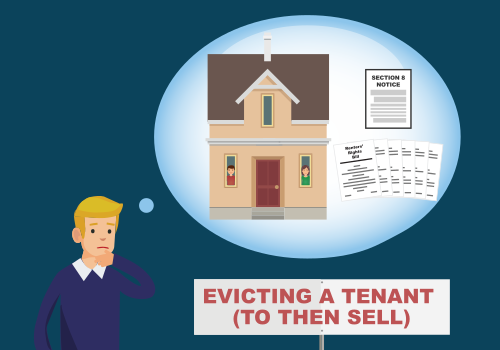
Evicting a Tenant (Then Sell Your Property)
Selling a property can become more difficult when a tenant refuses to cooperate or stops responding to communication.
Typical warning signs include ignored emails, text messages or phone calls and a reluctance to discuss the future of the tenancy. While there may sometimes be genuine reasons for a lack of response, persistent silence can signal a more serious problem.
Before starting formal legal action, it is usually worth emailing or messaging the tenant to try and resolve the situation amicably. Eviction proceedings these days are costly and time-consuming, so a cooperative solution is by far the best way forward.
If this approach fails, you may ultimately need to begin the formal possession process…
Possession Under the Renters’ Rights Act
Under the Renters’ Rights Act, landlords can no longer rely on Section 21 “no-fault” evictions to regain possession of their property.
Instead, landlords must now rely on the Section 8 possession process, which requires a valid legal ground for ending the tenancy.
At the same time, periodic tenancies are now the default, meaning tenants can remain in the property indefinitely unless one of the statutory possession grounds applies. These include:
- Persistent or serious rent arrears
- Breaches of the tenancy agreement (AST)
- Anti-social behaviour
- The landlord wishes to sell the property
- The landlord or a close family member intends to move into the property
Where the landlord intends to sell, the legislation now provides a specific possession ground allowing the tenancy to be ended for this purpose. However, the correct notice must be served. The court may also still review the case before granting possession.
Because of these changes, regaining possession can take longer than under the previous system – particularly if the tenant disputes the notice or the case proceeds to court.
Given these complexities, many landlords choose to seek professional legal advice or specialist eviction services before taking action.
Section 8 Possession Notices
Under the current regime, landlords must serve a Section 8 notice when seeking possession. This notice sets out the legal ground being relied upon and the relevant notice period before court proceedings can begin.
For example:
- Rent arrears grounds generally require the tenant to be at least two months behind on payments.
- Selling the property grounds allows landlords to regain possession where they genuinely intend to place the property on the market.
If the tenant does not leave once the notice period expires, the landlord must apply to the court for a possession order. If granted, the court may issue:
- A standard possession order, requiring the tenant to leave within a specified period; or
- A bailiff-enforced possession order in cases where the tenant refuses to vacate the property.
Because the courts will review the evidence carefully, landlords must ensure the correct procedures and documentation have been followed.
Selling With Vacant Possession
If you plan to sell the property with vacant possession, it is important to ensure that the tenant has fully vacated the property before exchange of contracts. Buyers and their solicitors will normally require confirmation that the property will be delivered empty on completion.
If there is uncertainty about whether the tenant will leave, the buyer is well within his/her rights to delay the sale. Some may also withdraw from the purchase or seek a price reduction (which, of course, you are under no obligation to accept).
For this reason, despite the loss of rent, many sellers wait until the tenant has officially vacated and returned the keys before proceeding with a sale.
Contact Property Solvers
Property Solvers’ freephone line is open 24 hours, 7 days a week on 0800 044 3696. Please also complete our contact form, start a chat at the bottom right of your browser or visit our sell tenanted property page.
We’ll take the time to understand what your current situation is regarding your tenanted properties and run through your best options.
Frequently Asked Questions
Deciding whether to sell a buy-to-let property (or not) will ultimately depend on your own goals.
Some have accidentally become landlords, hate the experience and cannot wait to get rid of the property. Others have their eye on long-term financial gains and are willing to bear the burdens of operating in the sector.
Wherever you find yourself, it’s always worth having a good think before making any decisions you’ll regret down the line…
You may have already made your mind up but, before thinking about putting your rental property on the market, it’s worth asking yourself the following questions:
- If it’s affordable, is it worth working with a reputable lettings agent to deal with the day-to-day issues (and therefore keep your investment more passive)?
- Have you talked to an experienced Independent Financial Advisor (IFA) about your long term goals and whether selling is a good idea?
- Have you run a simple cashflow “stress test” (voids, repairs, insurance, tax, compliance and a contingency) and compared the net return to what you could achieve by redeploying the (post-tax) equity into other investments or paying down debt?
- Have you looked at your remortgaging options? Even though borrowing is stricter these days, there are still some very good deals available for buy-to-let property owners. It may be worth contacting an experienced mortgage broker;
- If you own multiple properties, perhaps it would be worth selling one or two to pay down some of the debt? Then you could keep the better-performing properties that do not give you so much trouble. Here, you would also reduce your exposure in the event of a market downturn;
- Perhaps you have another asset from which you could tax-efficiently withdraw funds to pay down your secured debts (therefore reducing your exposure to Section 24?
- If you’re selling because of Section 24, have you spoken to an accountant about how you could potentially mitigate the effects of this tax? If, for example, you plan to only borrow a small amount against the property or have no mortgage at all (i.e. “unencumbered”), your exposure will be negligible.
Selling a rental property held in a Limited company is slightly different from selling in your personal (individual) name.
The company itself is the legal owner, so any sale proceeds (profit) remain within the business and are subject to Corporation Tax rather than Capital Gains Tax.
If you plan to extract the funds personally (for example, via dividends or salary), there may be further tax implications. You should also factor in any outstanding company liabilities and the accounting treatment of the asset.
Given the complexities, it’s always worth speaking to a qualified accountant / tax advisor before proceeding.
Absolutely, we have done this ourselves and created a genuine “win-win” experience for all.
It can also simplify the process significantly – no marketing, no viewings and potentially a smoother transaction.
Nonetheless, you should still carry out the usual due diligence. This includes ensuring the tenant has a mortgage agreement in principle and proof of deposit funds before progressing too far.
You can’t avoid CGT in any legitimate way if it is due. Any suggestion otherwise should be treated with extreme caution.
There are various reliefs and allowances available depending on your circumstances, but aggressive schemes promising to eliminate tax entirely are often non-compliant and can lead to serious consequences with HMRC.
Not immediately. The new owner takes over the tenancy under the existing terms, meaning the current rent and conditions remain in place.
Any rent increases must follow the correct legal process, which typically involves serving formal notice and adhering to statutory limits and timeframes. The Renters’ Rights Act also introduces further controls around rent increases.
No – there is no legal requirement to disclose the sale price to the tenant.
That said, maintaining open and honest communication can help keep things amicable, particularly if you need their cooperation for viewings or access.
In most cases, tenants are much more concerned about their future living situation than your selling price.
Yes, but only if the buyer is happy to proceed on that basis.
If the sale is agreed on a vacant possession basis, buyers and their solicitors will usually require confirmation that the tenant has already vacated before exchange. Without this certainty, there is a risk of delays, renegotiation or the buyer pulling out altogether.
For this reason, many sellers prefer to secure vacant possession first before progressing to exchange.


